Work Stoppage Due to Frost or Snow - Do You Keep Your Pay?
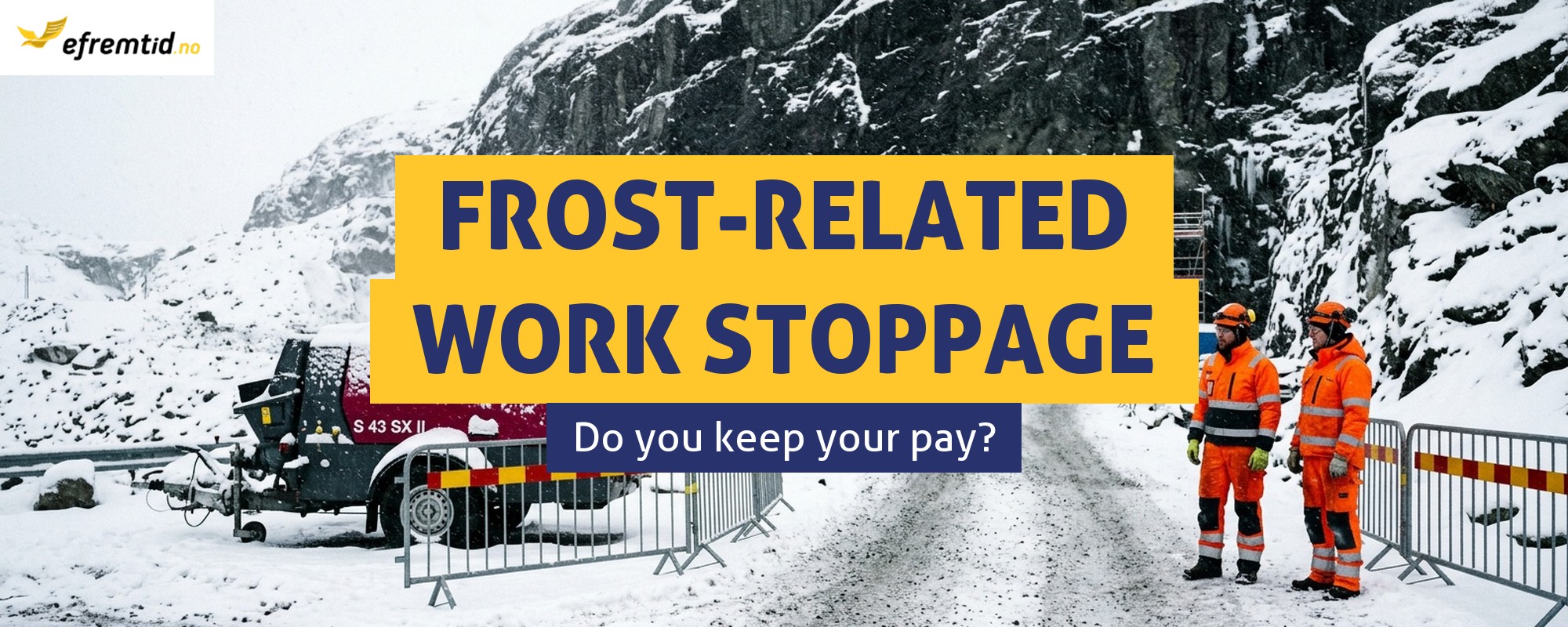
Has frost stopped work on a construction site, has snow blocked deliveries, or has your employer sent the whole crew home? In this situation, the question arises whether you are still entitled to pay for a cancelled shift.
In this article, we explain the importance of proper permittering (temporary layoff), how an ordinary Norwegian winter differs from an extraordinary natural event, and when the employer's payment may be replaced by dagpenger from NAV. The rules and amounts given are current for 2026.
When does an employee keep their pay?
Frost, snow or an inability to carry out work does not automatically deprive you of your right to pay. If you remain available for work and your employer cancels your shift, they generally still have to pay your agreed salary.
To be temporarily released from the obligation to pay, the employer must have an objective, temporary reason related to the business and apply permittering correctly. Your employment relationship continues, but you stop working fully or partly. You can read more about the procedure itself in our article What does permittering mean and what rights do you have?
| Situation | Right to pay |
|---|---|
| The employer cancels work but does not apply permittering correctly | You generally retain your regular pay |
| Permittering due to typical winter conditions | Regular pay during the notice period, followed by employer-paid remuneration for 15 working days |
| Permittering directly caused by an extraordinary natural event | No 15-day employer-paid period if the conditions for the statutory exception are met |
| The workplace is operating, but you cannot get to work because of snow | You do not automatically have the right to pay for your absence |
An employer cannot simply announce that the entire day is unpaid because of bad weather. If the required notice period has not been observed, you may claim pay for the missing part of that period.
Ordinary winter conditions versus an extraordinary natural event
Typical snowfall, seasonal frost and predictable problems occurring in winter may justify permittering if they genuinely prevent work. However, they are usually not enough to skip the 15 days of employer-funded pay.
The exception applies to fire, accidents or extraordinary natural circumstances. It follows from § 3 of the permitteringslønnsloven. In the case of permittering directly caused by such an event, the statutory 15-day pay period does not apply.
| Feature | Ordinary winter conditions | Extraordinary natural event |
|---|---|---|
| Example | Typical frost, regular snowfall, predictable disruptions on a construction site | Sudden extreme cold, flooding, a landslide or an event of an unusual scale |
| Predictability | Conditions that normally occur in the given location and season | An unusual, sudden or difficult-to-predict event |
| Notice period | Generally 14 calendar days | Generally 2 calendar days, if the conditions for a shortened notice period are met |
| Pay after permittering begins | 15 working days funded by the employer | No 15-day pay period |
The assessment depends, among other things, on the place where the work is carried out, the season, weather forecasts, the scale of the event and the possibility of moving employees to other tasks. A temperature that is unusual in southern Norway may be a normal winter condition in the north of the country.
The employer should also demonstrate that they have taken reasonable measures to limit the work stoppage. Relevant factors may include the possibility of changing working hours, securing the worksite, heating the workplace or assigning other duties.
How does payment work during permittering?
For permittering caused by winter conditions, the payment sequence is as follows:
Notice period
This generally lasts 14 calendar days. The employee receives normal pay, regardless of whether the employer provides work.
The first 15 working days of permittering
The employer pays remuneration calculated according to the rules applicable to the employer-paid period.
After the pay period ends
The employee may move on to dagpenger from NAV if they meet the benefit requirements and have submitted an application.
In the case of full permittering, the daily payment corresponds to the average pay for one working day. In the case of partial permittering, the employer pays for the work performed, while the days in the pay period accrue in proportion to the reduction in working hours. With a 50% reduction in working hours, it may take around 30 working days to accrue the equivalent of 15 full days.
The 15 days do not include periods when you would not have worked anyway, such as holiday leave or full sick leave. Saturdays, Sundays and public holidays count only if you were scheduled to work on those days.
Once you lose the right to remuneration, you may apply for dagpenger. In 2026, the benefit is generally 62.4% of your previous income, while NAV takes into account income up to a maximum of NOK 819,294, which is 6 G. NAV also deducts a waiting period equivalent to 3 benefit days. We describe the detailed conditions in the article Unemployment benefit in Norway - what are the rules?
If you want to submit your documents efficiently, we will be happy to prepare the application for you: Dagpenger unemployment benefit/permittering.
Temperature, safety and getting to work
Norwegian regulations do not specify one temperature below which outdoor work must automatically be stopped. The -20°C threshold found in some industry agreements is not a general statutory limit for all employees.
The employer must assess the following as a whole:
- temperature and wind strength,
- humidity and precipitation,
- the type and intensity of the work,
- time spent in the cold,
- access to a heated room,
- protective clothing and equipment.
Depending on the risk, additional protective clothing, more frequent breaks, a heated rest area or a change in work organisation must be provided. We discuss clothing rules in more detail in the article Does an employer in Norway have to provide workwear and winter work clothes?
You should not leave your workstation on your own simply because you consider the temperature too low. Report the issue to your supervisor, safety representative or occupational health service. The safety representative may stop work if continuing it poses an immediate risk to health or life.
The situation is different when the company is operating normally, but snow, ice or cancelled transport prevents you from getting to work. Responsibility for getting to work generally rests with the employee. A solution may be agreed remote work, a later shift start, making up the hours, holiday leave or unpaid leave.
What should you do after work is cancelled because of the weather?
After receiving information that work has been cancelled, determine whether the employer has implemented permittering and on what basis they intend to stop your pay.
NAV recommends submitting your application around 2 weeks before the last day you are entitled to pay. If you do not yet have all the attachments, the missing documents should generally be sent within 14 days.
Keep your employment contract, work schedule, time records, messages about cancelled shifts, permittering notice and payslips. If your employer refuses to pay, first send a written request for an explanation and payment of the amount due. We describe the next steps in the article What should you do if your employer in Norway does not pay your wages?
You do not have to handle a dispute with your employer on your own. We will be happy to help you recover your money through the Recovery of amounts owed by a former employer service.
FAQ - frequently asked questions
Summary
- Frost or snow do not automatically result in the loss of your right to pay.
- In ordinary permittering, the employer generally pays wages during the notice period and for the next 15 working days.
- The exception to the 15-day period applies to extraordinary natural circumstances, not typical winter weather.
- If the workplace is operating but you cannot get to work, you do not automatically have the right to pay for your absence.
If you need help determining your right to pay during a weather-related work stoppage, call us: +47 21 38 38 21. We help Poles in Norway put their employment and benefit matters in order.
Article author: Marcin - marcin@efirma.no