Inkasso in Norway - what should you do after receiving a payment demand?
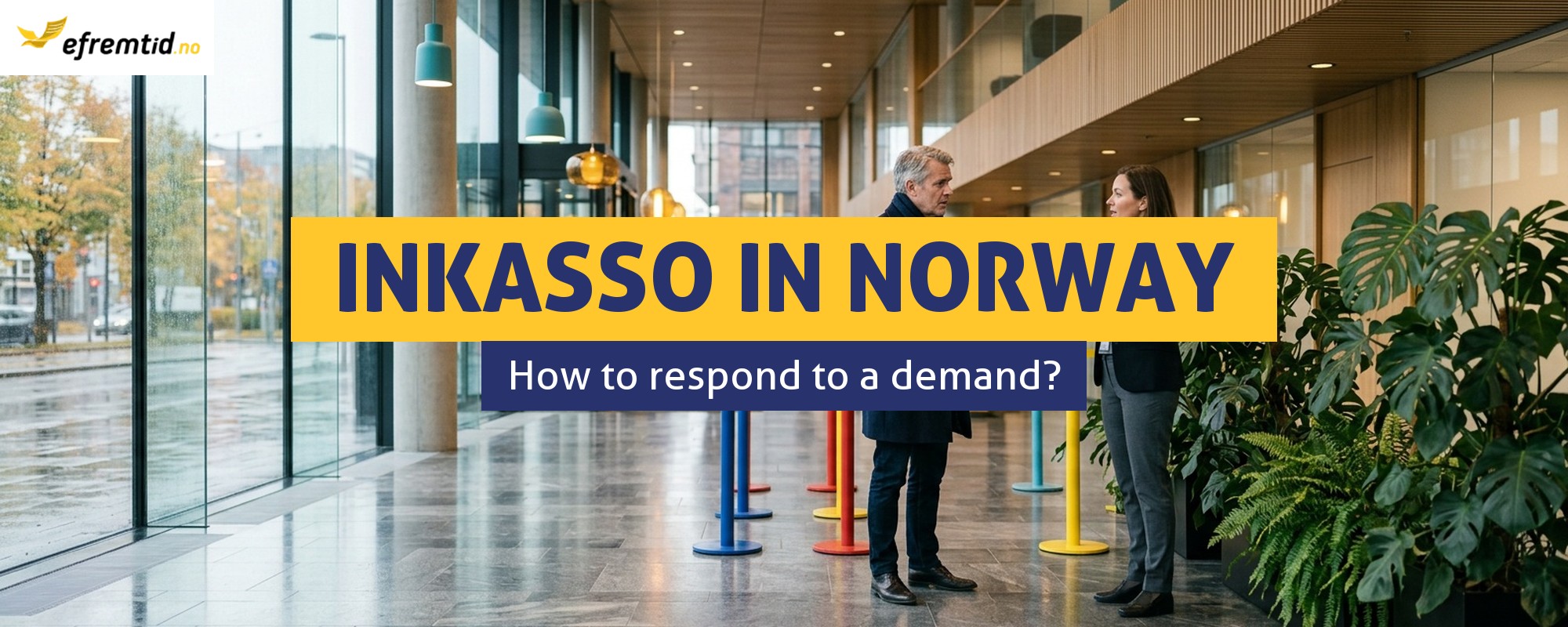
Have you received a letter from a debt collection company and are wondering whether you need to pay immediately? Or perhaps you do not recognise the invoice, the amount is incorrect, or your current financial situation does not allow you to settle the entire debt?
In this article, we explain how to check a demand, when to file an objection, how to ask for instalments, and what costs and consequences may arise if the case continues. We outline the rules and rates applicable in Norway in 2026.
How can you identify the stage of the case?
Inkasso (debt collection) begins when a due debt has not been paid. Before transferring a case to an external company, the creditor must send a valid notice of planned debt collection. A regular payment reminder is not a mandatory step.
| Document or stage | What it means | Minimum deadline |
|---|---|---|
| Payment reminder | A voluntary reminder from the creditor | No requirement to send one first |
| Inkassovarsel (debt collection warning) | States that non-payment will result in the case being transferred to debt collection | At least 14 days from the date it is sent |
| Betalingsoppfordring (demand after debt collection begins) | Includes a breakdown of the debt and a deadline for payment or objection | At least 14 days from the date it is sent |
| Legal proceedings | The case is referred to the conciliation board or enforcement authority | Requires a prior warning and compliance with the required deadlines |
The minimum 14-day deadline for a debt collection warning follows from Section 9 of the Inkasso Act. The notice may be sent by post or through a secure electronic channel, for example via a digital mailbox.
Receiving a warning or demand from a debt collection company does not automatically result in a negative credit record.
What should you do immediately after receiving a demand?
First, establish who is demanding payment, what the debt relates to, and whether all amounts charged are correct. Do not make a transfer based solely on an SMS or email without verifying the sender and bank account.
You can check an external debt collection company in the register of entities licensed to provide debt collection services. You can also compare the organisation number with the details in Brønnøysundregistrene. The account number should match the information provided by the company through an official channel.
In particular, check:
- the name of the original creditor,
- the case number and invoice number,
- the description of the goods, service, or contract,
- the principal amount, interest, and debt collection costs,
- the interest rate and the date from which it is charged,
- the deadline for payment or filing an objection,
- the KID number and bank account.
Not collecting an earlier letter does not automatically invalidate the debt collection process. If the document was securely sent to your current address in the Folkeregisteret or to the electronic address you provided, the procedure may be valid even if you did not read the message.
How should you respond to a payment demand?
Your next steps depend on whether you acknowledge the claim and whether you can settle it by the specified deadline. Respond in writing so that you retain proof of the content and date of contact.
The debt is correct and you can pay it
Pay the full amount before the deadline, using the correct KID number. A payment order accepted by the bank before the deadline is considered to have been made on time.
After making the transfer:
- keep the payment confirmation,
- check whether the payment covers the principal amount, correct interest, and costs,
- send the confirmation to the debt collection company if the deadline is close or the payment has not been registered.
If you have already paid the invoice, do not pay it again. Send proof of the transfer and request that the case be closed.
The debt is correct, but you cannot pay it in full
Contact the debt collection company before the deadline. Present a realistic proposal for deferred payment or instalments, taking into account your income and essential expenses.
Request written confirmation of:
- the amount and due dates of the instalments,
- how further interest will be charged,
- any additional fees,
- the suspension of further action provided that payments are made on time.
A plan involving more than four instalments may increase the maximum out-of-court costs by 1.5 inkassosats, which in 2026 is NOK 1,125. If you need support with negotiations, we will be happy to help you prepare a request: Payment deferral or splitting an invoice into instalments.
The debt is incorrect or only partly correct
Immediately send a written objection to the debt collection company, and preferably also to the original creditor. It is not enough to write that you disagree with the debt. State a specific reason and attach evidence.
Grounds for an objection may include:
- the invoice has already been paid,
- the contract was terminated before the period covered by the invoice,
- goods were returned or a complaint was accepted,
- an incorrect amount was charged,
- the debt was assigned to the wrong person,
- interest or costs were overstated,
- the ordered service was not provided.
Attach proof of payment, contract termination, correspondence, a complaint, or proof of return. Also request a full breakdown of the claim and suspension of ordinary debt collection proceedings.
If the objection is not clearly unfounded, the claim becomes disputed. The debt collection company may not continue ordinary debt collection. It must attempt to reach an agreement, close the debt collection case, or refer the matter to the conciliation board. This follows from Section 22 of the Inkasso Act.
If you dispute only part of the claim, you can pay the undisputed part. In the payment reference and message, clearly state which invoice and part of the debt the transfer covers.
What costs may be added in 2026?
After the deadline has passed, the creditor charges late payment interest. If a payment deadline was agreed in advance, interest generally runs from the day after that deadline. If no deadline was specified, interest generally begins to accrue 30 days after a written payment demand was sent.
| Type of cost or rate | Amount in 2026 |
|---|---|
| Inkassosats | NOK 750 |
| Chargeable payment reminder | Maximum NOK 38 |
| Inkassovarsel | Maximum NOK 38 |
| Betalingsoppfordring when the creditor pursues the debt itself | Maximum NOK 113 |
| Statutory interest from 1 January to 30 June 2026 | 12.00% per year |
| Statutory interest from 1 July to 31 December 2026 | 12.25% per year |
| Rettsgebyr, the standard court fee | NOK 1,345 |
A reminder fee may be charged if the reminder was sent no earlier than 14 days after the original payment due date. The same rule applies to a chargeable debt collection warning.
The maximum external debt collection costs charged to a consumer depend on the amount of the claim and on whether the creditor is entitled to deduct VAT on debt collection services.
| Principal amount | Standard or doubled cost where the creditor deducts VAT | Standard or doubled cost where the creditor does not deduct VAT |
|---|---|---|
| Up to NOK 500 | NOK 187.50 / 375 | NOK 234.38 / 468.75 |
| Up to NOK 1,000 | NOK 262.50 / 525 | NOK 328.13 / 656.25 |
| Up to NOK 2,500 | NOK 300 / 600 | NOK 375 / 750 |
| Up to NOK 10,000 | NOK 600 / 1,200 | NOK 750 / 1,500 |
| Up to NOK 50,000 | NOK 1,200 / 2,400 | NOK 1,500 / 3,000 |
| Up to NOK 250,000 | NOK 2,700 / 5,400 | NOK 3,375 / 6,750 |
| Above NOK 250,000 | NOK 5,400 / 10,800 | NOK 6,750 / 13,500 |
The standard cost arises when a valid demand is issued after debt collection has begun. If you exceed the deadline stated in that demand by more than 28 days, the maximum cost may be doubled. These are out-of-court costs added separately from the principal amount and interest.
The debt collection company loses its right to some or all out-of-court costs if it breaches the required deadlines, overcharges fees, applies unlawful pressure, or continues ordinary debt collection despite a justified objection. This does not automatically extinguish a valid principal claim and interest.
What happens if you ignore inkasso?
Once the deadlines expire without result, the creditor may refer the case to the forliksrådet (conciliation board) and then to the enforcement authority. Before enforcement begins, you must generally receive a written warning with a deadline of at least 14 days.
The enforcement authority may:
- secure funds in your bank account or assets,
- order deductions from your salary, pension, or NAV benefits,
- determine that you currently have no income or assets from which enforcement can be carried out.
When deductions are made from income, you must be left with funds for necessary household maintenance and reasonable housing costs. We describe this in more detail in the article Livsoppholdssatser - how much should remain after deductions from your salary.
Having no assets subject to attachment does not remove the debt. The outcome of enforcement may interrupt the limitation period and start a new ten-year period.
A negative credit record may make it more difficult to obtain credit, sign up for a subscription, or enter into certain contracts. A demand from a debt collection company alone does not result in registration. For private claims, a further legal step is generally required. Once the debt, valid interest, and costs have been paid in full, the record should be removed.
If you dispute the procedure or costs, first submit a written complaint to the debt collection company. If you do not receive a satisfactory response, as a consumer you can refer the case to Finansklagenemnda Inkasso. The board assesses matters including deadlines, costs, and how debt collection was conducted, but generally does not determine whether the principal claim itself exists.
If you are facing more serious financial problems, you can use NAV's free financial and debt counselling service at 55 55 33 39. An adviser can help you organise your debts, prepare a budget, and contact creditors.
FAQ - frequently asked questions
Summary
- After receiving inkasso, check the creditor, basis of the debt, deadlines, interest, costs, and bank account number.
- Pay a valid debt by the deadline or immediately propose a realistic instalment plan.
- Dispute an incorrect claim in writing, stating a specific reason and attaching documents.
- Ignoring the matter leads to additional costs, legal proceedings, enforcement, and the risk of a negative credit record.
If you need help responding to inkasso and settling a payment demand, call us: +47 21 38 38 21. We will help you organise the matter and choose the right next steps.
Article author: Marcin - marcin@efirma.no