Does an Employer in Norway Have to Provide Workwear and Winter Clothing?
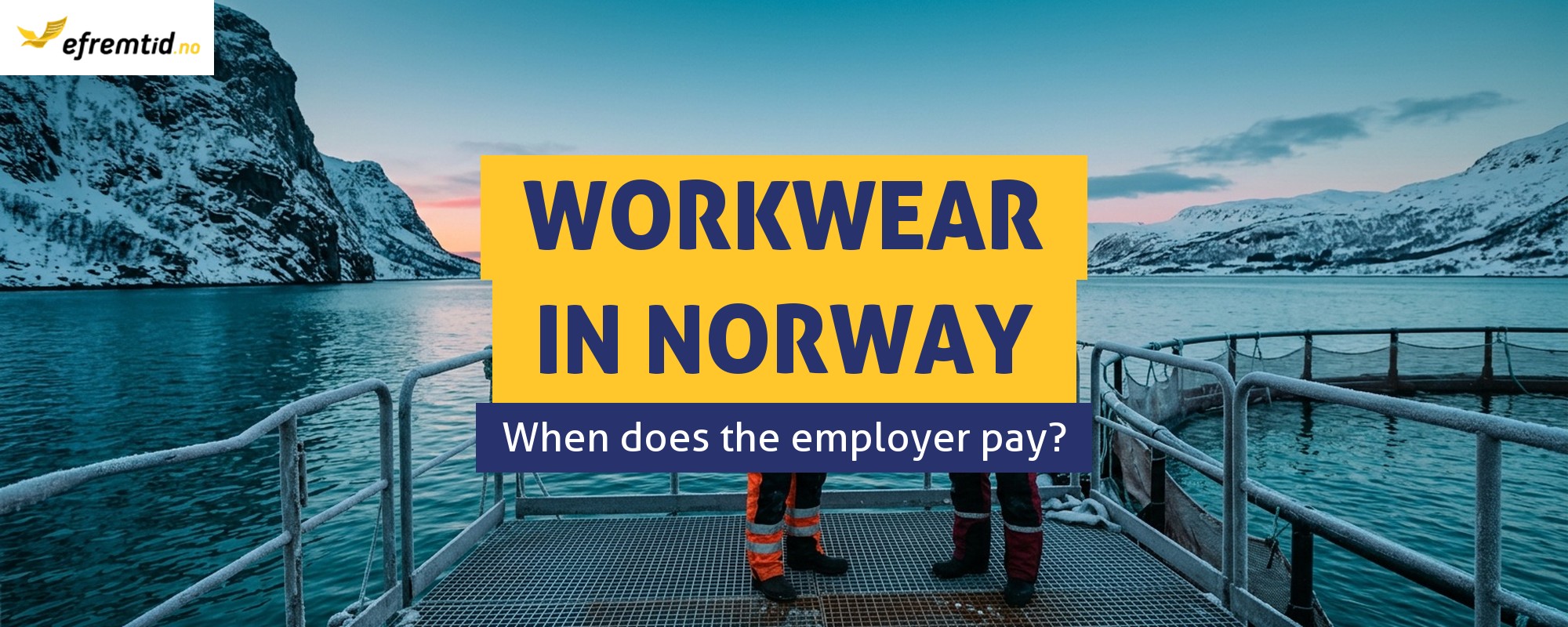
Do you work in construction, a cold store, a warehouse, or outdoors during the Norwegian winter? You may be wondering whether you have to buy a warm jacket, gloves, and footwear yourself, or whether your employer should provide them.
In this article, we explain the difference between regular workwear and clothing that protects your health. We also discuss the employer's obligations, rules for working in cold conditions, and what you can do if you do not receive adequate protection.
When must an employer provide clothing?
In Norway, there is no general rule requiring every employer to provide regular workwear. However, this obligation may arise from:
- regulations applicable to a specific industry,
- a collective agreement,
- an employment contract,
- workplace regulations,
- internal company arrangements.
The situation is different for clothing needed to protect life or health. If an employee is exposed to cold, moisture, wind, or another hazard, and regular clothing does not provide sufficient protection, the employer must provide suitable protective clothing free of charge.
This obligation follows from Section 15-1 of the Regulations concerning Organisation, Management and Participation. Personal protective equipment must be used when the risk cannot be sufficiently reduced in another way.
Workwear versus protective clothing
The intended purpose of the clothing is crucial. The fact that clothing is used at work does not automatically mean that it is personal protective equipment.
| Feature | Regular workwear | Protective clothing |
|---|---|---|
| Main purpose | Identifying the employee, creating a uniform appearance, or protecting private clothing | Protecting health or safety against a specific hazard |
| Example | A bus driver's uniform or a company T-shirt | Clothing for a cold store, thermal gloves, waterproof protective clothing |
| General employer obligation | Depends on the industry, contract, and applicable arrangements | The employer must provide it when required by the risk assessment |
| Cost | Depends on the basis of the obligation and the arrangements | Covered by the employer |
A warm jacket used during short periods of outdoor work is not always protective clothing. It becomes so when working conditions create a health risk and the employee's regular winter clothing does not provide adequate protection.
An example is work in a cold store or freezer. Clothing that protects against the temperature there is personal protective equipment, which means the employer is responsible for selecting and funding it.
Protection against cold in the workplace
The employer must carry out a risk assessment, taking into account, among other things:
- temperature and perceived cold,
- wind strength,
- humidity and precipitation,
- time spent in the cold,
- the intensity of the work performed,
- the possibility of warming up during breaks,
- the employee's individual needs.
First, the hazard must be reduced through technical and organisational measures. This may mean shielding the workstation, providing local heating, changing tasks, reducing exposure time, adding extra breaks, or providing access to a heated room. If the risk remains, the employer must provide suitable protective clothing.
Depending on the conditions, the following may be needed:
- an insulated jacket and trousers,
- windproof and waterproof clothing,
- thermal underwear,
- gloves that protect against cold,
- insulated safety footwear,
- protection for the head, face, and neck,
- a specialist outfit for work in a cold store or freezer.
According to Section 15-4 of the regulations on personal protective equipment, equipment must be adapted to the employee and working conditions. The employer is also responsible for:
- ensuring the equipment is in proper technical condition,
- cleaning, maintenance, and repair,
- hygienic storage,
- replacing worn or damaged items,
- providing clear instructions and training,
- ensuring that protective items used at the same time are compatible.
Protective clothing should have CE marking, a declaration of conformity, and instructions in Norwegian. The employee is obliged to use the allocated equipment correctly and report any damage.
Temperature and stopping work
Norwegian regulations in force in 2026 do not set one minimum temperature at which work must automatically stop. The -20°C limit used by some companies may result from local rules, but it is not a nationwide statutory threshold.
For light indoor work, it is recommended during the heating season to avoid temperatures below 19°C and above 26°C, while also keeping the temperature below 22°C. These are recommendations, not absolute legal limits.
For outdoor work, what matters is the combined impact of temperature, wind, moisture, and exposure time. Employees must have access to a place where they can warm up if required for safety and health. This follows from Section 2-24 of the Workplace Regulations.
If work is carried out outdoors or in a wet environment, the company should also provide an appropriate way to dry wet clothing and footwear.
Industries where regular workwear must be provided
In some industries, the employer's obligation also covers regular workwear. Under regulations in force in 2026, this applies, among others, to the following employees:
| Industry | What does the employer provide? | Important rules |
|---|---|---|
| Construction work on building sites | Necessary workwear, insulated clothing, rainwear, gloves, and safety footwear | Clothing must be suitable for the season and workplace. The clothing remains company property |
| Private cleaning companies | Necessary workwear and footwear | Equipment must be adapted to the place and type of work |
| Shipbuilding and shipyard industry | Necessary clothing and workwear | Clothing must meet safety requirements and be properly fitted |
In construction, clothing should be issued upon employment, and a worn-out set must be replaced with a new one once it is returned. If a unisex model does not provide an appropriate fit, the employer must provide clothing tailored for women and men.
The obligation to provide special clothing may also arise from exposure to biological agents, asbestos, or hazardous substances. Contaminated clothing must not be taken home for washing. The employer is responsible for safe cleaning and, where necessary, disinfection.
What should you do if your employer does not provide protection?
If you are cold at work or the available clothing does not protect you against water, wind, or low temperatures, report the problem as specifically as possible. Simply saying that it is cold may not be enough for a proper risk assessment.
If you believe that continuing to work creates an immediate risk to life or health, you must stop performing the task and immediately notify the employer and the verneombud (safety representative). The employee's obligation follows from Section 2-3 of the Norwegian Working Environment Act.
If the cold has caused frostbite, an injury, or another health impairment, also check how to report a workplace accident in Norway.
FAQ - frequently asked questions
Summary
- Regular workwear does not have to be provided in every occupation unless the obligation arises from industry regulations, a contract, or other arrangements.
- Clothing that protects health against cold, moisture, and wind is funded by the employer if regular clothing does not provide sufficient protection.
- The employer is responsible for risk assessment, selection, cleaning, maintenance, replacement, and proper use of protective equipment.
- Norway does not have a single statutory temperature limit, such as -20°C, above which work is automatically stopped.
If you need help determining your employer's obligations regarding workwear and protection against cold, call us: +47 21 38 38 21. We will help you sort out the situation and choose the next steps.
Article author: Marcin - marcin@efirma.no