Winter in Norway - is there a requirement to fit winter tyres? What about studs and chains?
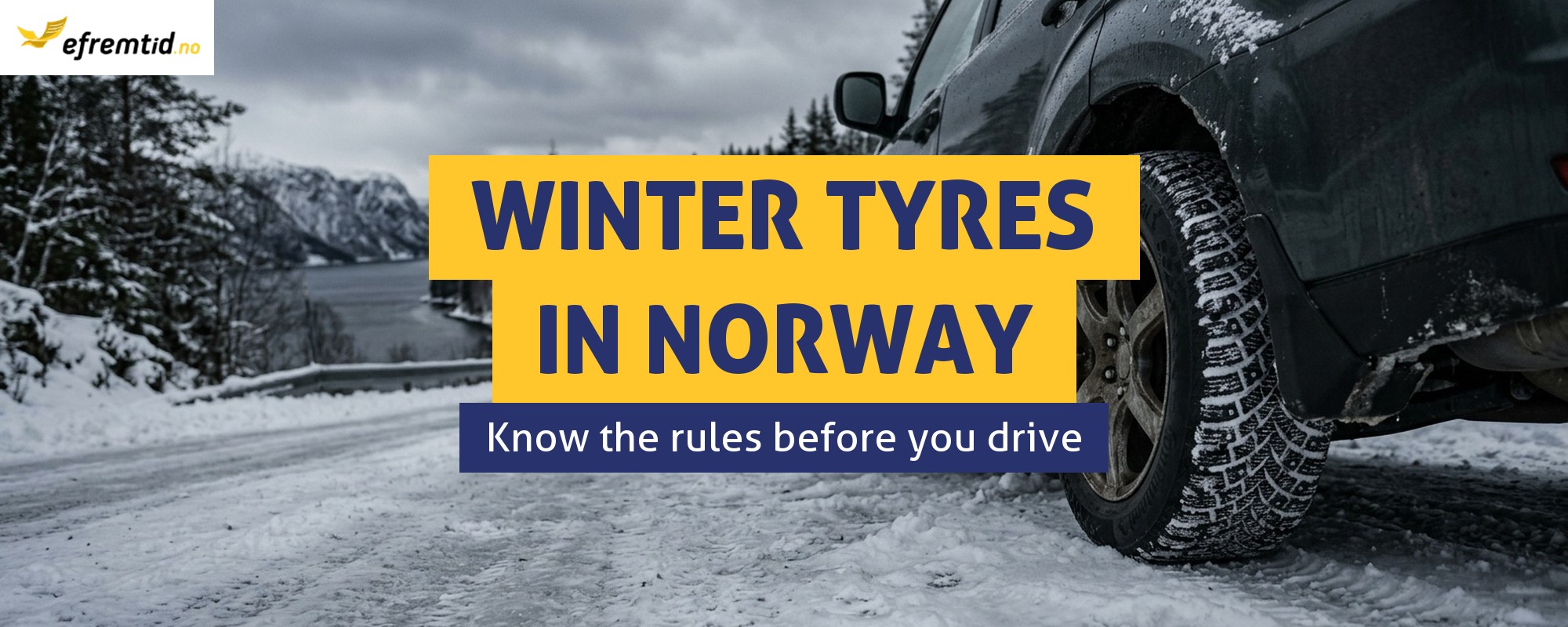
Rules on the use of winter tyres vary from country to country. There are some countries in Europe, such as the United Kingdom and Denmark, where the law does not regulate the use of winter tyres at all. In most cases, winter tyres are mandatory during certain periods or when weather conditions require them. The use of chains on certain stretches of road or in specific areas may be compulsory. Before travelling abroad in winter, drivers should check the winter tyre rules in the relevant country carefully to avoid problems caused by using the wrong tyres.
Tyre requirements
In winter, there is a requirement to have tyres with a tread depth of at least 3 millimetres. If you are driving a vehicle with a trailer, the same tread depth requirements apply to the trailer tyres as to the vehicle tyres. It is important that the tyres are in good condition and suitable for the vehicle and road conditions, regardless of the season. As a driver, you are responsible for ensuring sufficient grip for the vehicle throughout the year. Remember that the correct tyre markings and tread depth do not guarantee sufficient grip.
Tyre tread depth requirements vary depending on the season:
 In winter, from 1 November to the first Sunday after 2 Easter Day, a minimum tread depth of 3 millimetres is required. The length of time this requirement applies may vary each year, depending on the date of Easter.
For the regions of Nordland, Troms and Finnmark, the requirement for a minimum tread depth of 3 millimetres applies from 16 October to 30 April.
In summer, from the first Sunday after 2 Easter Day to 1 November, tyre tread depth should be at least 1.6 millimetres. Summer tyres must not be used on winter roads, as summer tyres do not provide sufficient grip on ice and snow.
If it is necessary to ensure adequate grip, the vehicle must be fitted with winter tyres, with or without studs, chains or similar - also outside the periods mentioned above.
There are separate tread depth and winter tyre requirements for vehicles weighing over 3,500 kg.
When can studded tyres be used?
Studded tyres may be used from 1 November to the first Sunday after 2 Easter Day. In the regions of Nordland, Troms and Finnmark, studded tyres may be used from 16 October to 30 April.
If road conditions require it, the use of studded tyres and chains is also permitted outside these dates. If you use studded tyres, the vehicle should have studded tyres on all wheels.
Non-studded winter tyres may be used all year round.
Tyre markings
Depending on the country and the situation in Europe, both non-studded and studded tyres may be used. Safe winter tyres, whether studded or non-studded, carry the snowflake symbol (also known as the 3PMSF marking or 3-Peak-Mountain-SnowFlake), gradually replacing the current winter tyre marking (M+S).
The M+S marking is no longer sufficient in countries such as Germany, where the law requires winter tyres to have the snowflake symbol. The M+S marking is also being replaced by the snowflake symbol in the Nordic countries.
Studded or non-studded tyres?
 Non-studded winter tyres designed for Central European conditions are a good choice for milder and wetter winters on the continent. In the Nordic countries, winter is much harsher, with large amounts of snow, ice and frozen water on the roads. This calls for non-studded tyres designed specifically for Nordic conditions. Safe non-studded winter tyres, both for Central Europe and Nordic conditions, are marked with the snowflake symbol. To help consumers distinguish Nordic non-studded winter tyres from their European counterparts, the tyre industry is developing a special ice grip marking.
Studded tyres are popular in the Nordic countries, but they are banned in countries such as Germany and Poland. In some countries there are also separate speed limits for cars with studded tyres, and the car must also be marked with a sign indicating this.
Chains on wheels
In some European countries, the use of wheel chains is recommended or required on certain stretches of road. You may see road signs indicating that chains must be used, for example in the mountain regions of Austria and Switzerland. In other places, it is enough to have chains in the car.
The minimum tread depth requirements for winter tyres are 3 millimetres in most European countries. Nokian Tyres recommends replacing winter tyres when 4 millimetres of tread depth remain. Tyre steering performance drops significantly below this level.
Remember this when hiring a car
Hiring a car after arrival can be a convenient solution when you do not want or are unable to drive all the way. When ordering the vehicle, you should ask for it to be fitted with winter tyres. Ultimately, the driver is always responsible for ensuring that the car is properly equipped for the journey.