Who Is Entitled to Disability Benefit in Norway?
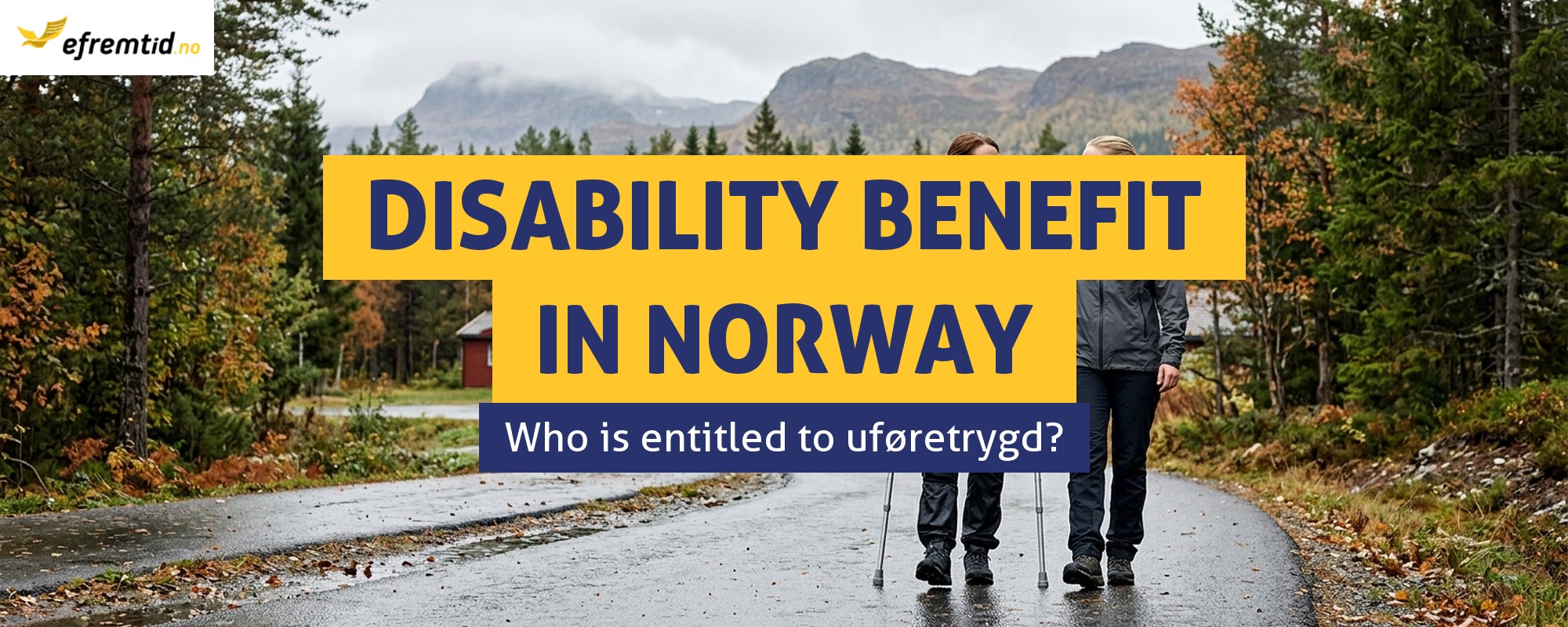
Disability benefit from NAV in Norway, or uføretrygd (a benefit due to a lasting reduction in earning capacity), applies to people who, because of their health condition, cannot earn income as they used to. In practice, many questions arise when an illness lasts a long time, sykepenger ends, or NAV carries out an assessment through arbeidsavklaringspenger, or AAP.
In this article, we explain who is entitled to uføretrygd, what conditions must be met, how NAV looks at incapacity to work, and what is especially important for Poles living or working in Norway.
What uføretrygd is and what NAV assesses
Uføretrygd is a benefit from NAV for a person whose ability to earn income has been permanently reduced because of illness, injury, or a congenital condition. The legal basis is folketrygdloven, chapter 12.
The key concept is inntektsevne (earning capacity). NAV assesses how much you can realistically earn after an illness or injury compared with what you could earn before. A medical diagnosis alone does not determine entitlement to the benefit. What matters is how the illness affects your functioning, work ability, scope of duties, and income.
Example: two people may have the same diagnosis, but different levels of limitation. One may still be able to work a lot after workplace adjustments, while the other may have such severe limitations that their earning capacity is permanently reduced.
Main conditions for receiving uføretrygd
The right to uføretrygd applies to a person who meets the conditions related to age, health, membership in the Norwegian social security system, and the degree of reduced earning capacity.
| Condition | Rule in 2026 | What it means in practice |
|---|---|---|
| Age | 18-67 years | Uføretrygd applies to people before reaching retirement age |
| Health reason | Illness, injury, or congenital health condition | The health condition must be the main reason for the reduced income |
| Permanence | As a rule, a condition expected to last about 7 years or longer | If a significant improvement can be expected in the short term, the permanence requirement may not be met |
| Membership in folketrygden | As a rule, the last 5 years before the incapacity arose | This refers to membership in the Norwegian social security system |
| Reduced earning capacity | As a rule, at least 50% | NAV compares your income situation before and after the illness |
A lower threshold for reduced earning capacity applies in certain situations:
| Situation | Minimum reduction in earning capacity |
|---|---|
| Standard uføretrygd case | 50% |
| When you were receiving AAP at the time of the application | 40% |
| When the incapacity results from an approved work injury or occupational disease | 30% |
If you are at the AAP stage, it is worth first understanding the rules for that benefit well. We explain them separately in the article Arbeidsavklaringspenger (AAP) - key information.
You can also, if needed, get our help with AAP-related matters: AAP - arbeidsavklaringspenger - benefit after an injury or longer incapacity for work.
Membership in folketrygden and periods from Poland
Folketrygden (the Norwegian social security system) is very important when assessing the right to uføretrygd. As a rule, you must have been a member for the last 5 years before the point at which you became unable to earn income.
For Poles, periods of work and insurance in Poland and other EU/EEA countries are important. In certain situations, such periods may be combined with the Norwegian period when assessing entitlement to the benefit. This is especially important when you do not have a full 5 years in Norway, but were previously covered by social security in Poland.
There are exceptions to the 5-year rule, including in cases of:
- an approved work injury or occupational disease,
- incapacity arising before reaching 26 years of age,
- very long membership from age 16 with short breaks,
- a situation where you have earned the right to at least half of the minimum benefit.
If you live abroad, you can still apply for Norwegian uføretrygd if you previously lived or worked in Norway and meet the conditions. When you live in an EEA country, the application is generally submitted through the social security institution in your country of residence.
Treatment, rehabilitation, and assessment of work ability
Before uføretrygd is granted, it usually has to be clarified whether your earning capacity can be improved through treatment, rehabilitation, or work-related measures. NAV assesses whether appropriate and purposeful measures were used, meaning measures that could realistically improve your ability to earn income.
In practice, the following are important, among other things:
- documentation from your GP and specialists,
- a description of the diagnosis and functional limitations,
- the course of treatment and rehabilitation,
- attempts to return to work or adapt the job,
- an assessment of how much you can still work despite the illness,
- information from NAV about work-related measures.
If you refuse appropriate treatment, rehabilitation, or work-oriented measures without a justified reason, NAV may deny uføretrygd. The situation is different when treatment is particularly risky, very demanding, or the documentation confirms that work-related measures make no sense because of the severity of the health condition.
In very serious cases, for example with an incurable illness or very severe functional limitations, NAV may conclude that further treatment or work-related measures are no longer relevant.
Application for uføretrygd and processing time
An application for uføretrygd is usually submitted once the case has been sufficiently clarified by NAV. This means that your local NAV advisor should first assess your health, work, and income situation.
The estimated processing times for uføretrygd cases are as follows:
| Type of case | Estimated processing time |
|---|---|
| Application for uføretrygd | 6 months |
| Application for barnetillegg (child supplement) | 4 months |
| International application when you live abroad | 22 months |
NAV's decision, or vedtak (administrative decision), can be appealed. In uføretrygd cases, the complaint deadline is generally 6 weeks, but always check the deadline stated in the vedtak itself. If you need support after a refusal, feel free to use our appeal help: NAV - appeal against a decision, complaint.
Special situations, rates, and taxes
Some groups have additional conditions or special rules for calculating the benefit. This most often applies to people aged 62-67, people entitled to the ung ufør status, and people supporting children.
People aged 62-67
If you apply at the age of 62-67, NAV generally requires that you had pensjonsgivende inntekt (income that forms the basis for calculating pension benefits) of at least 1 G in the year before the time of incapacity. From 1 May 2026, 1 G is NOK 136,549.
An exception may apply to a person who earned a total of at least 3 G over the last three years before the incapacity. In 2026, 3 G is NOK 409,647. In addition, such a person cannot be entitled to a full alderspensjon (old-age pension).
Ung ufør
Ung ufør (young person permanently unable to earn income) is a special entitlement within uføretrygd, not a separate benefit. NAV assesses it on its own initiative, so you do not submit a separate application only for the ung ufør status.
The conditions are stricter than for ordinary uføretrygd. The illness or injury must be serious, permanent, and arise before reaching 26 years of age, and the medical documentation must clearly confirm both the health condition and the incapacity before age 26.
If after turning 26 you worked more than 50%, the application must be submitted before reaching 36 years of age. If work was below 50%, there is no similar deadline.
Minimum annual rates from 1 May 2026
The amount of uføretrygd depends, among other things, on previous income, the degree of incapacity, the insurance period, and any minimum rates. At a 100% degree of incapacity, the benefit from NAV in 2026 can range from NOK 318,023 to NOK 540,734 per year before tax.
| Type of minimum rate | Annual amount from 1 May 2026 |
|---|---|
| Standard rate - person living with a spouse, partner, or samboer | NOK 318,023 |
| Standard rate for ung ufør - living with a spouse, partner, or samboer | NOK 369,911 |
| High rate - single person on uføretrygd | NOK 345,332 |
| High rate for ung ufør - single person | NOK 404,048 |
Uføretrygd is taxed like employment income. In 2026, the benefit is subject, among other things, to trygdeavgift (social security contribution) at a rate of 7.6%. If you receive uføretrygd, it is worth making sure your tax card is correct.
FAQ - frequently asked questions
Summary
- Uføretrygd is granted to a person aged 18-67 whose ability to earn income has been permanently reduced because of illness, injury, or congenital disability.
- As a rule, at least 50% reduction in earning capacity is required, but with AAP the threshold is 40%, and with an approved work injury or occupational disease 30%.
- As a rule, you must have 5 years of membership in folketrygden, but periods from Poland and other EU/EEA countries may be relevant when assessing entitlement.
- Before granting the benefit, NAV usually requires clarification of treatment, rehabilitation, and real work possibilities.
If you need help applying for uføretrygd, call us: +47 21 38 38 21. We help Poles in Norway organize their NAV matters.
Article author: Marcin - marcin@efirma.no