What is kontantstøtte and who is eligible?
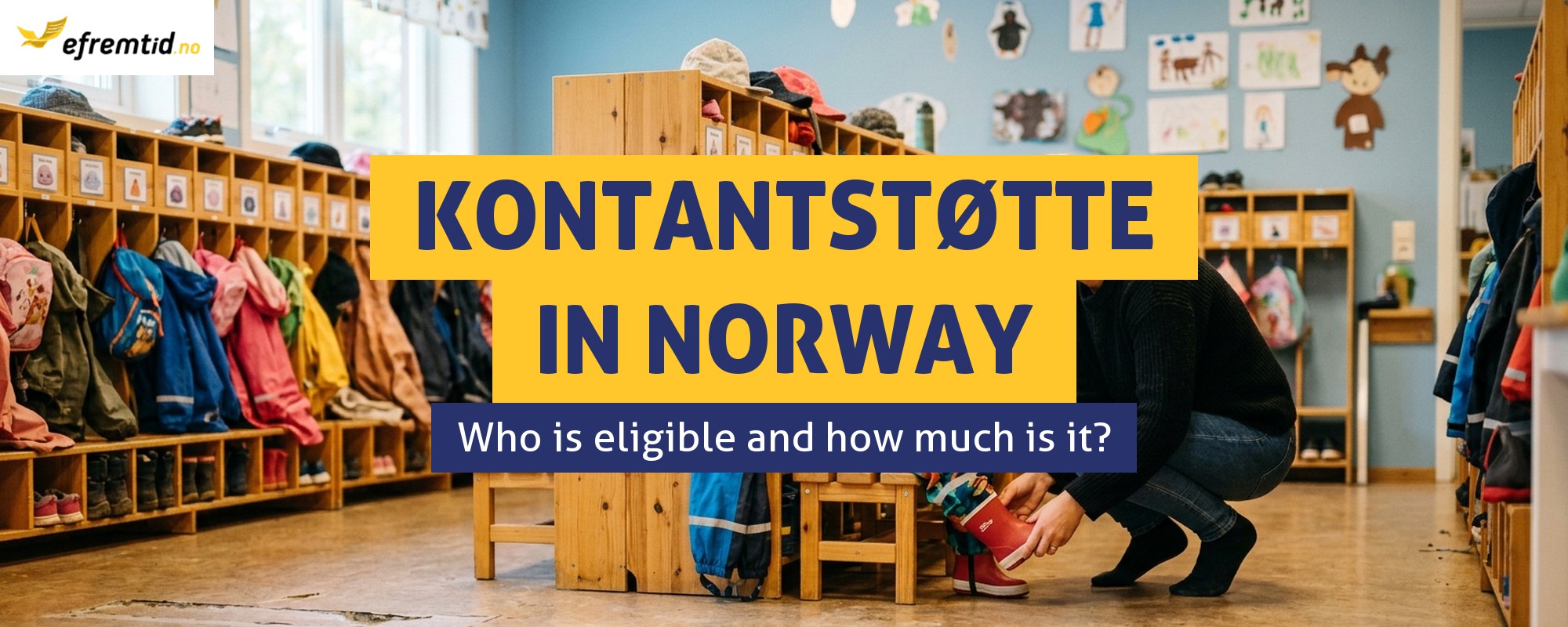
Do you have a young child and arrange care without a full-time kindergarten place? In that situation, it is worth checking whether you are eligible for Norwegian kontantstøtte.
In this article, we explain who is eligible for the benefit, how much it is in 2026, how the number of hours in kindergarten affects the payment, and what changes when the child lives in Poland.
What is kontantstøtte and who can receive it
Kontantstøtte is a cash benefit for families with a young child who does not have a full-time place in a publicly funded kindergarten. The benefit can be paid in full or in part, depending on the formal number of hours granted for the child's place.
The parents' income does not affect the amount of kontantstøtte. You can work full-time or part-time and receive the benefit if you meet the other conditions.
For a biological child, eligibility covers the period:
- from the month in which the child turns 13 months old,
- until the end of the month in which the child turns 19 months old,
- for a maximum of 7 months.
The basic conditions are as follows:
- the child is within the eligible age range,
- the child does not have a place in a publicly funded kindergarten for at least 33 hours per week,
- the person receiving the benefit lives permanently with the child,
- the applicant has the required period of social insurance coverage,
- the family meets the residence conditions in Norway or the EEA coordination rules.
The applicant must have at least 5 years of membership in the Norwegian National Insurance Scheme or relevant periods of insurance or residence in other EEA countries. These periods do not have to be consecutive. If the child lives with both parents, as a rule, each parent must meet the five-year requirement.
For an adopted child, the benefit can be paid for a maximum of 7 months after the full period of parental benefits ends. In the case of adoption, the age limit works differently - the child may be older than 19 months but must not be subject to compulsory schooling or have started primary school.
The rules for this benefit are set out in the Kontantstøtte Act. We discuss other child-related benefits in the article Family benefits in Norway - what can we expect?
How much is kontantstøtte in 2026
The full rate in 2026 is NOK 7,500 per month per child. Paid for the maximum 7 months, this amounts to a total of NOK 52,500.
The amount of the benefit depends on the number of hours stated in the kindergarten contract:
| Granted kindergarten place | Percentage of benefit | Monthly amount in 2026 |
|---|---|---|
| No place | 100% | NOK 7,500 |
| Up to 8 hours per week | 80% | NOK 6,000 |
| 9-16 hours per week | 60% | NOK 4,500 |
| 17-24 hours per week | 40% | NOK 3,000 |
| 25-32 hours per week | 20% | NOK 1,500 |
| 33 hours per week or more | 0% | NOK 0 |
What matters is the formally granted place, not the child's actual attendance. If the child has a full-time place but attends kindergarten only once a week, kontantstøtte is not available.
This applies to both municipal kindergartens and private facilities receiving public funding. Private care provided by parents, grandparents, a nanny or another person does not in itself exclude eligibility for the benefit.
Kontantstøtte when the family lives in Poland
Kontantstøtte is subject to coordination of family benefits within the EEA. Therefore, a child living in Poland does not automatically exclude eligibility for payment if one parent works in Norway and is covered by the Norwegian social insurance system.
The most common situations are as follows:
| Family situation | What it means for kontantstøtte |
|---|---|
| The whole family lives in Norway | The benefit may be available if the age, kindergarten, residence and insurance conditions are met. |
| One parent works in Norway and the child lives in Poland | Eligibility may arise under EEA rules even though the child does not live in Norway. |
| The other parent works in Poland or receives a benefit treated as occupational activity | Poland may have primary responsibility for payment, and Norway will pay only any difference. |
| The parent living with the child in Poland does not work | Norway may be responsible for the full payment if the other parent works in Norway and the remaining conditions are met. |
| The employee is posted from Poland and remains covered by the Polish system | Work performed in Norway alone does not entitle the person to Norwegian kontantstøtte. |
Polish insurance or residence periods may be added to the required 5-year period, but they must be documented. In a cross-border case, you must provide accurate details of the child and the other parent, the address in Poland, and information about employment and benefits received in both countries.
How to apply and what to keep in mind
Kontantstøtte is not granted automatically. You must submit an application to NAV. You can do this at the earliest in the month when the child turns one.
Depending on your situation, prepare:
- the child's birth certificate, if the child is not listed in the Norwegian Population Register,
- a document confirming legal residence,
- adoption documents, if applicable,
- an agreement on the child's shared residence,
- an employment contract and identification document for an EEA case,
- documents confirming insurance periods in Poland or another EEA country,
- identification details, addresses and employment information for both parents.
Retroactive payment may cover a maximum of 3 months before the month in which you submit the application, provided that you met the conditions throughout that entire period. It is therefore not worth delaying the submission of documents.
The indicative processing times, valid as of 25 August 2026, are:
| Type of application | Indicative processing time |
|---|---|
| Standard domestic application | 2 months |
| Application requiring EEA coordination | 8 months |
If you want to avoid missing documents, we will be happy to prepare the application for you as part of our Kontantstøtte - childcare benefit service.
Once the benefit has been granted, you must report the following to NAV, among other things:
- being granted a kindergarten place or a change in the number of hours,
- a change in the child's place of residence,
- moving or a planned longer stay abroad,
- a change in employment or country of social insurance coverage,
- the other parent starting work abroad,
- being granted a similar benefit in another EEA country.
Failing to report a change creates a risk that you will have to repay amounts paid without entitlement.
FAQ - frequently asked questions
Summary
- Kontantstøtte is generally available for a child aged 13 to 19 months, for a maximum of 7 months.
- The full rate in 2026 is NOK 7,500 per month, and a granted kindergarten place may reduce or exclude payment.
- A parent's income and work do not affect the amount of the benefit, but the residence and social insurance conditions must be met.
- A child living in Poland may be covered by the benefit under EEA rules, and insurance periods from Poland may help meet the 5-year requirement.
If you need help applying for kontantstøtte, call us: +47 21 38 38 21. We help Polish people in Norway organise their benefit matters.
Article author: Marcin - marcin@efirma.no