How Many Sick Child Leave Days Are You Entitled to in Norway?
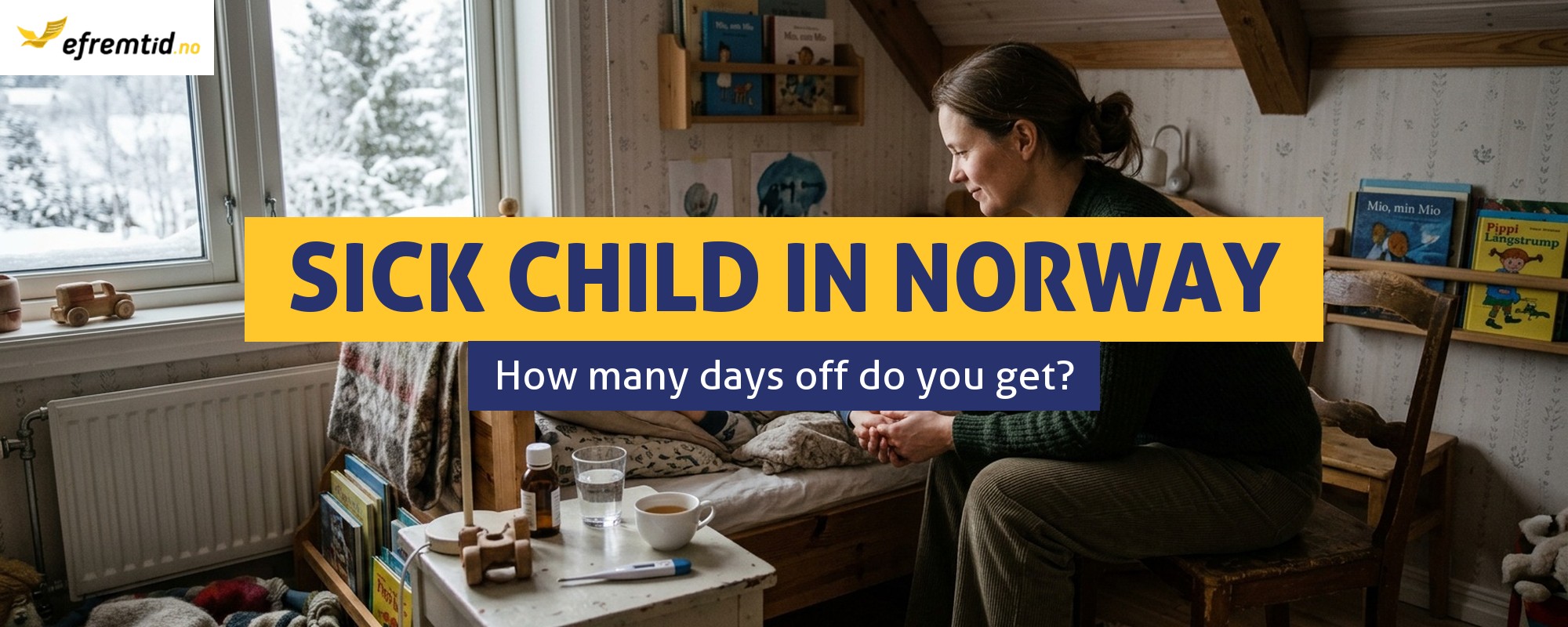
A sick child in Norway often means that many parents have to stay at home, cancel a work shift, or leave early for a doctor's appointment. In such situations, omsorgsdager (child care days) are used, commonly referred to as sick child leave days.
In this article, we explain how many days you are entitled to in 2026, when they are paid as omsorgspenger (child care benefit), who is entitled to extra days, and how to report your absence to your employer.
How many days are you entitled to in 2026
The standard omsorgsdager limit depends on the number of children. It is counted per calendar year, meaning the period from 1 January to 31 December.
| Parent situation | Number of days per calendar year | Up to what age of the child |
|---|---|---|
| The parent has 1 or 2 children | 10 days | Until the end of the year in which the child turns 12 |
| The parent has 3 or more children | 15 days | Until the end of the year in which the child turns 12 |
| A parent is the sole caregiver of 1 or 2 children | 20 days | Until the end of the year in which the child turns 12 |
| A parent is the sole caregiver of 3 or more children | 30 days | Until the end of the year in which the child turns 12 |
| The child has a chronic or long-term illness or a disability | 10 extra days per such child | Until the end of the year in which the child turns 18 |
| A single parent of a child with a chronic or long-term illness or a disability | 20 extra days per such child | Until the end of the year in which the child turns 18 |
If you have more than one employer, the limit is shared across all workplaces. It is your responsibility to keep track of how many days you use with each employer. If you change jobs during the year, the new employer has the right to ask how many days you have already used with your previous employer.
The basic rules come from folketrygdloven chapter 9 and from the right to time off when a child is ill under arbeidsmiljøloven § 12-9.
Who is entitled to paid omsorgsdager
It is important to distinguish between the right to time off and the right to paid benefits. You may be entitled to be absent from work because of a sick child, but if you do not meet the conditions for omsorgspenger, the absence will be unpaid.
To have sick child leave days paid, you must meet the basic conditions:
| Condition | What it means in practice |
|---|---|
| You care for the child | This generally means your own child living with you or a foster child |
| You cannot work because of care obligations | You must be absent from work and lose income because of that absence |
| You have the required income | The minimum annual income in 2026 is NOK 68,275 |
| You have worked long enough | As a rule, you must have worked at least 4 weeks before using paid days |
| You are covered by the Norwegian system | You must be a member of folketrygden (the Norwegian social security system) |
| The reduction in work or income is sufficient | Working time or income must be reduced by at least 20% |
| Age of the parent | The person receiving the benefit must be under 70 years of age |
The 4-week work period may also include certain benefit periods, for example sykepenger or foreldrepenger.
If you want to understand the difference between your own illness and a child’s illness, read our article: Sick note, sick pay and self-certification - what happens in case of illness in Norway?
Omsorgspenger covers income up to a maximum of 6G, which is NOK 819,294 per year in 2026. The current grunnbeløp (basic amount in the NAV system) from 1 May 2026 is NOK 136,549.
When you can use sick child leave days
You only use omsorgsdager on days when you were supposed to work. If the child is ill on your day off, you do not lose income and you do not use a care day.
| Situation | Can you use an omsorgsdag? | Brief explanation |
|---|---|---|
| The child has the flu, a stomach infection, or another illness and must stay home | Yes | The parent stays home because the child needs care |
| The child has a doctor’s appointment related to an illness | Yes | The day can also be used for a check-up or treatment |
| The child has a follow-up appointment with a doctor, physiotherapist, BUP or PPT | Yes | The condition is that it relates to illness or a need for care |
| The child’s caregiver, for example the other parent on parental leave or a nanny, is ill | Yes | The child loses daily care and the parent has to step in |
| The kindergarten is closed because staff are ill | Yes | The closure is caused by illness among the caregivers |
| A school meeting not related to illness | No | This is not care due to the child’s illness |
| A planleggingsdag at kindergarten or school | No | This is a planned closure day |
| A routine check-up for a healthy child or a dental visit unrelated to illness | No | There is no connection to illness or necessary care |
| School or kindergarten closure because of a strike | No | The cause is not illness of the child or caregiver |
The employer may accept part of a day as part of an omsorgsdag. If the company does not allow this, an absence of part of the day will be counted as a full day. For reimbursements, a full workday is counted as 7.5 hours.
Extra days: single care and chronic illness in a child
Extra days are granted in two situations: when a parent is a sole caregiver or when the child has a chronic or long-term illness or a disability.
Sole care of the child
A parent who is alene om omsorgen (the sole caregiver) has a double entitlement: 20 days for 1-2 children or 30 days for 3 or more children.
Sole care applies when the child lives permanently with you, you do not live with the other parent, and there is no agreed delt bosted (shared permanent residence with both parents).
If the other parent, for at least 6 months, is unable to care for the child for reasons beyond their control, for example due to illness, stay in an institution, disability, imprisonment, or military service, you must apply to NAV for recognition of the right to extra days.
A child with a chronic illness, long-term illness, or disability
If the child’s illness or disability clearly increases the risk of your absence from work, you apply for 10 extra days per year for each such child. A single parent receives 20 extra days.
A medical certificate must be attached to the application. The document should describe the illness or disability and explain how it increases the need for the parent to be absent from work. In the case of a long-term illness, the doctor should indicate the expected duration.
The application is submitted separately for each child. Once the extra days are granted, you must inform your employer how many days you are entitled to.
How to report absence and who pays
For ordinary sick child leave days, you do not submit an application to NAV. You report the absence to your employer according to the company’s rules.
Usually, the procedure looks like this:
An employee uses egenmelding (self-certification) for the first 3 days of absence. From day 4, the employer may require a medical certificate. The fourth day means the fourth consecutive day of absence, even if a weekend or another day off falls in between.
| Who uses the days | Who pays the benefit | Key rule |
|---|---|---|
| An employee after at least 4 weeks of work with the employer | Employer | The employer pays the benefit for care days |
| An employee entitled to more than 10 days per year | Employer, then reimbursement from NAV | The employer covers the first 10 days, and from day 11 requests reimbursement |
| An employee whose employer did not pay the benefit | NAV after the employee applies | NAV checks entitlement and requires information from the employer |
| A freelancer or self-employed person | Initially self-funded, then NAV | The first 10 days are covered by the person themselves, and from day 11 they apply to NAV |
Omsorgspenger paid by NAV are subject to withholding tax, meaning tax is withheld from the benefit during the year. This is not the final tax settlement - the final result is determined in the annual tax return.
If the employer pays the benefit, the employee usually does not submit a separate application to NAV. The employer handles any reimbursement through NAV solutions for employers. Information for private individuals can be found on the NAV omsorgspenger page.
FAQ - frequently asked questions
Summary
- In 2026, the standard entitlement is 10 days for 1-2 children or 15 days for 3 or more children.
- A single parent has a double entitlement: 20 days or 30 days, depending on the number of children.
- For a child with a chronic or long-term illness or a disability, you are entitled to 10 extra days, and a single parent to 20 extra days for each such child.
- For the first 3 days, egenmelding is usually enough, and from day 4 the employer may require a medical certificate.
If you need help determining your entitlement to sick child leave days in Norway, call us at +47 21 38 38 21. We help Poles in Norway organize their benefit and tax matters.
Article author: Marcin - marcin@efirma.no