Do I Have to Pay Tax on Selling Items on finn.no?
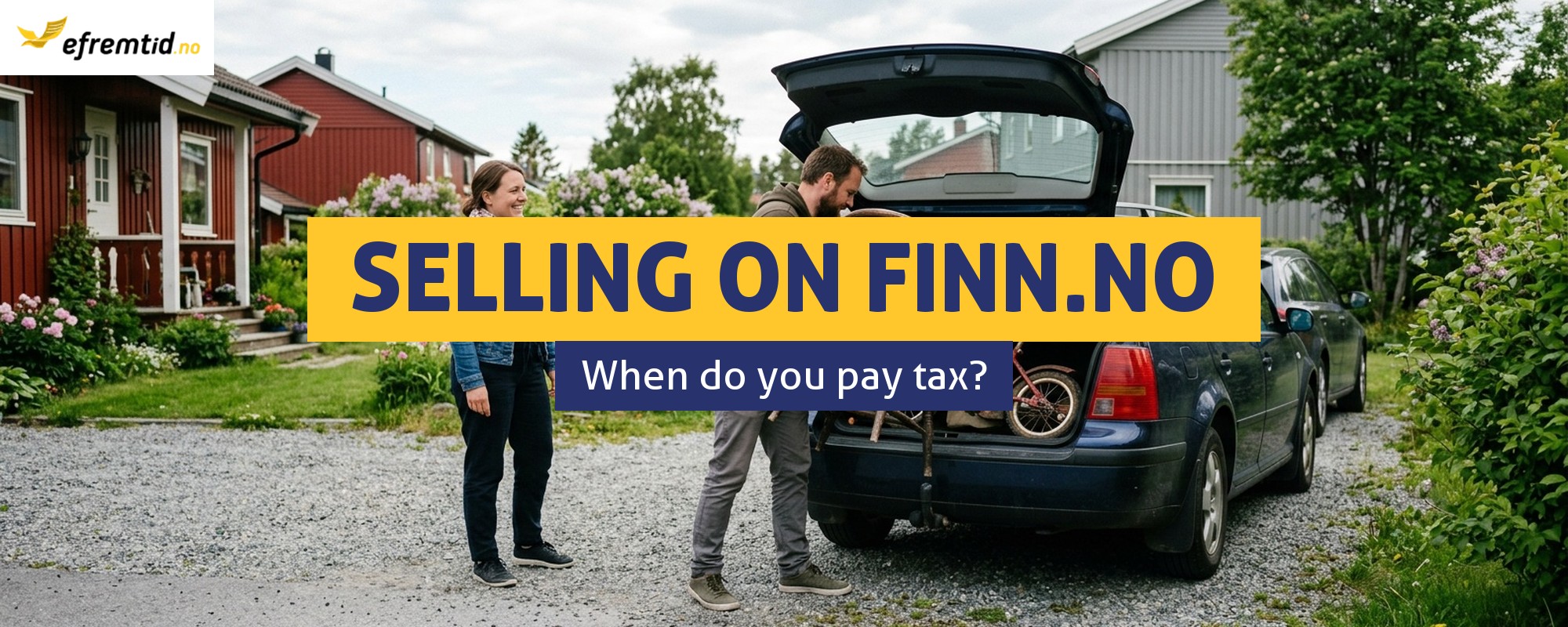
Selling a used sofa, bicycle, phone, or clothes on finn.no and wondering whether that sale needs to be included in your Norwegian tax return? That is a common question, especially when a move, a home clear-out, or the sale of several more expensive items adds up to a fairly large amount.
In this article, we explain how to distinguish ordinary private sales from taxable sales, when the intention to resell matters, and where the line of business activity is drawn.
When private sales on finn.no are tax-free
If you sell your own items that were used privately at home or in your household, the profit from the sale is exempt from income tax. This refers to the Norwegian innbo og løsøre (household goods and movable property used privately by you or your family). This rule covers the typical sale of items from your apartment, basement, garage, or holiday cabin.
Private items that you usually sell tax-free include, for example:
- furniture, beds, tables, chairs, lamps,
- clothes, shoes, toys, and children's items,
- phones, computers, TVs, household appliances, and consumer electronics,
- bicycles, skis, tools, and sports equipment,
- a private car, motorcycle, moped, caravan, or leisure boat,
- jewelry, antiques, works of art, or collectibles, if they were part of your private household property and not an investment bought with the intention of reselling.
You can find the basis for this rule in the explanation of the exemption for innbo og løsøre.
In practice, this means that if after moving you sell a used sofa for 4 000 NOK, a bicycle for 2 500 NOK, and a TV for 3 000 NOK, you do not pay tax on those sales, as long as the items were part of your private household belongings.
Important: in private sales of this kind, there is no separate threshold above which the sale automatically becomes taxable. The amount alone does not decide the matter. What matters is what you are selling, how the item was used, and with what intention it was purchased.
| Situation | Income tax | Why |
|---|---|---|
| You sell used furniture after moving | No tax | It is private household property used at home |
| You sell a private car used by the family | No tax | The car was private property, not a company fixed asset |
| You sell children's clothes after your children | No tax | It is ordinary sale of household items |
| You sell a private item for less than you paid | No tax and no deduction for the loss | A loss on private household property does not reduce tax |
When selling items is taxable
Tax arises when the item being sold does not fall within the private exemption or was bought with the intention of reselling it for profit. In that case, the gain may be capital income or business income, depending on the scale and method of sale.
The most common taxable situations are:
- you buy an item mainly as an investment and sell it for a higher price,
- you buy items cheaply on finn.no, at auctions, or at a loppemarked (flea market), and then resell them at a markup,
- you sell new or nearly new items that you have not used privately,
- you regularly restore, repair, or assemble items for resale,
- you run sales in an organized way, with stock, markup, and recurring transactions.
If the sale is taxable, you calculate tax on the profit, not on the full sales price. Profit means the sale price minus the purchase cost and direct costs connected with the sale, for example commission or shipping, if you paid them as the seller.
| Example | Tax treatment | What you report |
|---|---|---|
| You bought a limited-edition watch purely as an investment and sold it at a profit | Capital income | Profit from the sale |
| You regularly buy phones, repair them, and sell them at a higher price | Possible business activity | Business income and expenses |
| You sell a collection bought privately for home use, with no investment intent | Usually private sale | No tax if the exemption conditions are met |
| You sell 20 new pairs of shoes bought on sale with the intention of reselling them | Taxable sale | Profit from resale |
For taxable profit outside a business, you report it in the skattemelding (tax return) as other capital income. The standard tax rate on alminnelig inntekt (net income after deductions) in 2026 is 22% for most individuals. If you live in the tiltakssonen in Troms and Finnmark, the rate for this type of income is 18.5%.
If you have a larger or unusual private sale and are not sure whether to include it in your tax return, we will gladly help you go through the reporting step by step: Tax return in Norway
Private sale or business activity
Selling on finn.no becomes a tax issue most often when it stops looking like a one-time disposal of your own belongings and starts to resemble trade. Norwegian criteria for assessing business activity include four elements: the activity must have the ability to generate profit, some degree of continuity, some scope, and be carried out on your own account and at your own risk.
There is no single simple income threshold that by itself determines whether you are an entrepreneur. The overall circumstances matter.
| Feature of the sale | More like private sale | More like business activity |
|---|---|---|
| Purpose of purchase | The item was bought for you or your family | The item was bought for resale |
| Frequency | Occasional listings | Regular transactions |
| Organization | Home clear-out, moving, replacing equipment | Stock, repairs, advertising, markup |
| Risk | You sell your own used items | You buy goods and take the risk of loss |
| Profit | Accidental or no profit | Sales aimed at steady earnings |
If your sales meet the criteria for business activity, you report income and expenses as a business. For an enkeltpersonforetak (sole proprietorship, ENK), you file one skattemelding covering both the private part and the business data. We write more about taxes for ENK in the article What taxes do sole proprietorships pay in Norway?
For business activity, tax is also calculated on the profit, meaning income minus expenses. In 2026, profit from an ENK may be subject, among other things, to:
- 22% tax on alminnelig inntekt,
- 10.8% trygdeavgift for other business income,
- trinnskatt (progressive personal income tax) if you exceed the income thresholds.
Advance payments of forskuddsskatt (advance tax paid by a business owner during the year) are not the final tax. The final tax is determined only after the annual filing and the skatteoppgjør (tax assessment result).
FAQ - frequently asked questions
Summary
- Selling your own used items from home, such as furniture, clothes, a bicycle, electronics, or a private car, is generally tax-free.
- There is no automatic value threshold for private sales on finn.no.
- Tax arises when selling items bought as an investment, bought with the intention of resale, or through regular profit-oriented trading.
- For larger, unusual, or repeated transactions, keep documentation: proof of purchase, the listing, payment confirmation, and sales costs.
If you need help reporting the sale of items on finn.no, call us at: +47 21 38 38 21. We help Poles in Norway organize their tax matters.
Article author: Marcin - marcin@efirma.no